
Orange County Release Date Sources
The first question is whether the person is a pretrial detainee, serving an Orange County jail sentence, or in TDCJ. These paths use different records. A bond amount or court date is not a release date, and transfer out of Orange County Correctional Facility does not mean release into the community.
| Custody stage | Best source | Date limit |
|---|---|---|
| Pretrial county detention | OCSO roster and court docket | No sentence-based projection usually exists |
| County-jail sentence | Judgment, commitment, jail credit, sheriff calculation | Local calculation must be confirmed |
| TDCJ prison sentence | TDCJ offender search and information channels | Projected and scheduled fields may change |
| Parole review | Board and TDCJ status channels | Eligibility or approval is not physical release |
| Completed booking | OCSO Letter of Incarceration | Book-out proves the booking ended |
Use the Orange County court judgment to learn whether the person received jail, probation, or a state sentence. Then move to the custodian that actually calculates time.
Orange County Projected Versus Actual Release
A pretrial bond can create a possible path out, but it does not set the hour of release. Payment, acceptance, other cases, warrants, detainers, and booking work may still affect custody. Likewise, a court sentence does not show every later credit adjustment. Read the source closest to the stage being checked.
TDCJ defines a Projected Release Date as the date Classification and Records expects release if parole does not occur sooner. It is a calculation, not a promise. A Scheduled Release Date appears later, after release processing, a certificate, and an audit establish a schedule. TDCJ warns that a scheduled date can change without notice, even on that date.
- Projected Release Date
- A TDCJ calculation based on sentence and release rules if parole does not occur sooner.
- Scheduled Release Date
- A later date posted after release processing has advanced.
- Maximum Expiration Date
- The end of the sentence calculation.
- Parole eligibility date
- The point when review may occur, not a promised release.
- Discharge
- The end of the sentence or supervision obligation.
The TDCJ definitions page displays these date concepts.
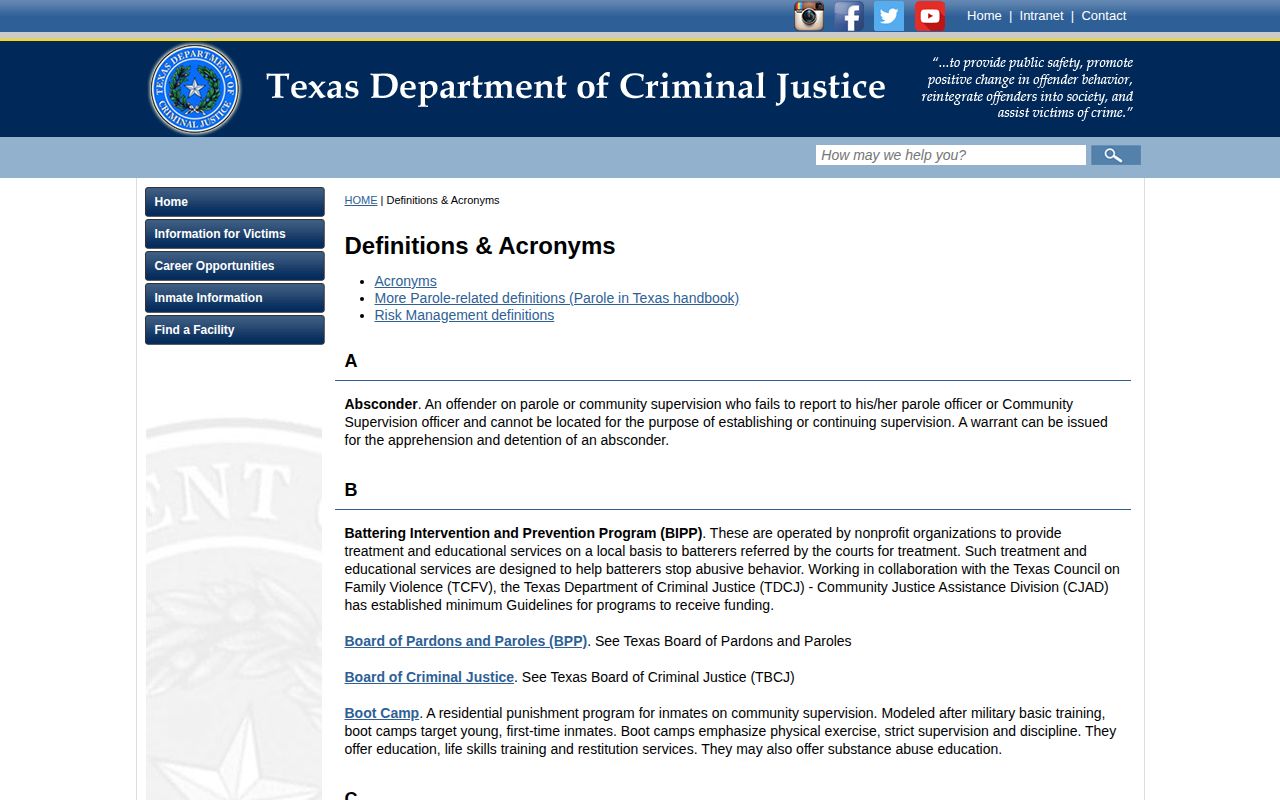
The official definition keeps an Orange County searcher from confusing a projection with confirmed departure.
Find Orange County Projected Release Dates
Gather identifiers before searching. TDCJ accepts a name, seven-digit TDCJ number, or SID number. For a common name, compare the birth date, county of conviction, offense, and location in the full record. Orange County jail records use the booking and court identifiers tied to the local confinement.
- Check the Orange County roster to determine whether the person remains in county custody.
- Read the court docket and judgment to identify pretrial status, probation, a county-jail sentence, or transfer to TDCJ.
- For TDCJ, search by number when possible and open the matching detail record.
- Read Projected Release Date, maximum expiration, parole review, and scheduled date as separate fields.
- If online data is unclear, request TDCJ information by email or telephone with the required identifiers.
- Confirm actual departure with the final agency status or Orange County Letter of Incarceration.
The TDCJ search form shows the official search fields and instructions.
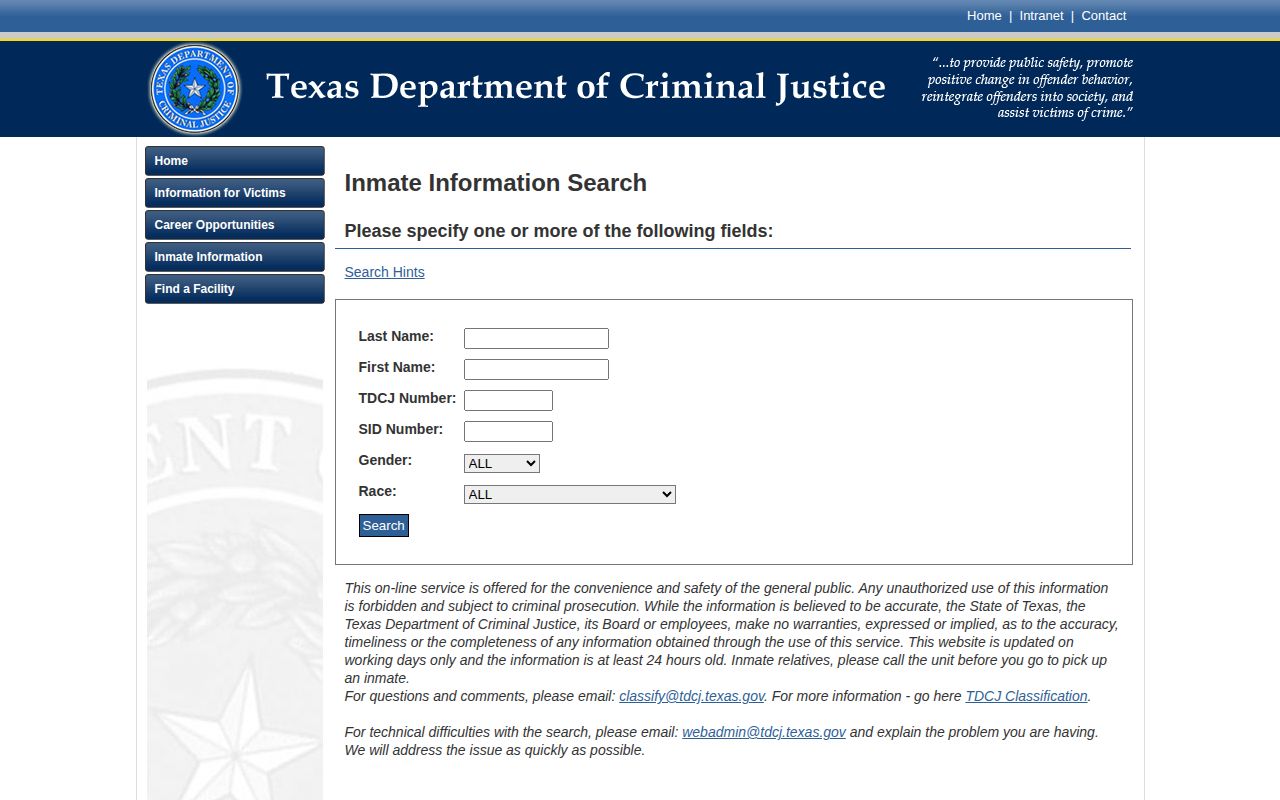
The available identifiers make a stronger match than name alone and help distinguish Orange County convictions from unrelated records.
TDCJ’s general information service is free. Its email route asks for the full name and TDCJ number. If that number is unknown, provide the exact date of birth or approximate age and county of conviction.
Texas Time Credits in Orange County
Texas Government Code §498.003 governs good-conduct time for eligible TDCJ prisoners. Section 498.004 covers forfeiture and restoration. Good time is a classification and release-calculation credit. It does not shorten the sentence imposed by the court, and it does not guarantee parole.
Government Code §508.145 contains parole-eligibility formulas and special offense rules. Section 508.149 lists categories excluded from mandatory supervision. Section 508.147 governs release to mandatory supervision, including the discretionary framework for later offenses.
For an eligible offense before September 1, 1996, TDCJ may project the point when flat time plus good time reaches the sentence. For an eligible later offense, the Board must approve discretionary mandatory supervision. A denial can move the displayed projection to maximum expiration. For an ineligible case, the projection generally equals maximum expiration unless parole occurs sooner.
Credits depend on official classification and records. Do not subtract an assumed number of days from a sentence. The actual offense date, offense category, judgment, eligibility, credit history, and Board action control.
No Orange County 85 Percent Rule
Texas does not apply one universal “85 percent” shortcut. That phrase often comes from federal truth-in-sentencing grant language and can distort a state case. Certain serious or aggravated offenses can require actual calendar time before parole eligibility, sometimes one-half of the sentence or thirty years, with caps and offense-specific rules. Good time may not advance that eligibility date.
Other offenses follow different formulas. Mandatory-supervision eligibility also varies. The only reliable calculation starts with the judgment, offense date, offense, sentence structure, and the rules in Government Code §§508.145 and 508.149.
County time is separate. Texas Code of Criminal Procedure Article 42.032 permits county-jail commutation for good conduct under the sheriff’s rules and statutory limits. Orange County did not publish a current local good-time schedule in the reviewed sources. No Orange County weekend-release policy was found either. The sheriff and judgment must supply the actual local answer.
Why Orange County Release Dates Change
A date can move for lawful reasons at both the record and release-processing stages. Some changes correct the sentence calculation. Others reflect a new event that affects when or where release may occur.
| Change | Possible effect | Where to confirm |
|---|---|---|
| Corrected jail credit or amended judgment | Moves the time calculation | Sentencing court and custodian |
| Good-time forfeiture or restoration | Changes an eligible TDCJ projection | TDCJ Classification and Records |
| New or consecutive sentence | Extends or restructures confinement | Court judgment and TDCJ |
| Detainer or hold | May cause transfer instead of community release | Current and receiving agencies |
| Parole vote or withdrawal | Can advance, condition, delay, or cancel release | Board and TDCJ status channels |
| Program or residence approval | Can delay certificate and departure | TDCJ Parole Division |
| Administrative audit | Corrects a posted schedule | TDCJ records channel |
TDCJ also distinguishes a scheduled release location from a future residence. The listed location is where processing occurs. It does not disclose where a person will live.
Orange County TDCJ Date Records
The TDCJ information-by-email page lists available data, including current incarceration information, conviction offense, county and court of conviction, prior incarceration history, location, and Projected Release Date.
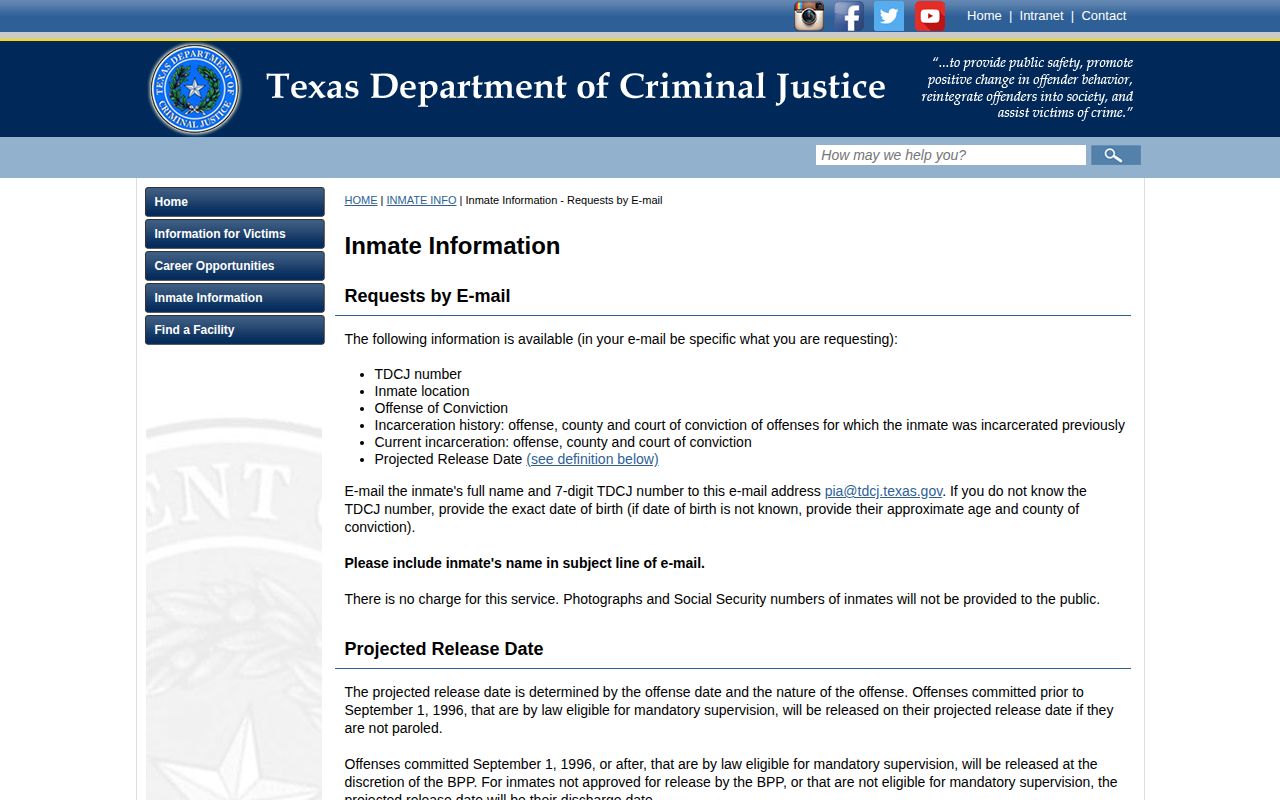
The official explanation also shows why a projected date should be requested from TDCJ instead of estimated from a county court sentence.
Use a formal TDCJ Public Information Act request when the general online, email, and telephone channels do not provide the needed existing record. Describe the record and identify the person by TDCJ number when possible. Government Code Chapter 552 provides access subject to corrections, privacy, safety, and other exceptions.
A person released from Orange County Jail on bond may never appear in TDCJ. Conversely, a transfer from the county jail to TDCJ means the jail booking ended while incarceration continued.
Confirm Orange County Actual Release
The public record may also show a maximum-expiration date or parole review date. Neither substitutes for actual release. Maximum expiration concerns the sentence calculation, while review marks a point at which the Board may act. Read each label in the official TDCJ definitions before comparing dates.
Record the date and source of each check. A later official update can explain why an earlier projection changed.
For a county booking, OCSO’s no-charge Letter of Incarceration gives book-in and book-out dates and the offense. Pair it with the judgment when the question concerns a county sentence or probation. Ask for release or transfer disposition only if maintained and releasable.
For a state sentence, compare the TDCJ detail with the Board and release-status channels. A favorable parole vote may still require release-plan checks, program completion, an approved residence, a certificate, and an audit. A Parole in Absentia case leaving a county jail may not receive the usual online scheduled date.
Registering for an alert can help track a future event, but use the separate Orange County VINE Inmate Check to choose between IVSS-Counties and TDCJ IVSS. The Orange County release records page covers the book-out request when the event already occurred.
Note: A blank date, a placeholder, or a missing person result is not proof that Orange County custody ended.