
Orange County Parole Versus Probation
Texas separates supervision by its legal source. Parole and mandatory supervision follow release from the Texas Department of Criminal Justice. The TDCJ Parole Division manages both. Probation, formally called community supervision, comes from a court judgment and is managed through a Community Supervision and Corrections Department. An Orange County resident can leave the county jail on probation without serving a TDCJ prison term.
The distinction determines where to look. A TDCJ record may show a state-prison release type and continuing parole status. An Orange County judgment identifies a probation term, its court, and later orders. Neither the live jail roster nor an absence from it establishes supervision.
| Record type | Who orders it | Where to verify |
|---|---|---|
| Parole | Texas Board of Pardons and Paroles | TDCJ offender and Board status channels |
| Mandatory supervision | Texas law and Board review | TDCJ offender information and Parole Division |
| Probation | Orange County trial court | Court judgment, docket, and Orange County Adult Probation |
| Discharge | Controlling agency or court | Final order or official agency confirmation |
- Parole
- Conditional community release before a prison sentence expires.
- Probation
- A court-ordered community sentence, also called community supervision.
- Mandatory supervision
- A form of TDCJ release governed by eligibility rules and, for many cases, Board review.
- Discharge
- The formal end of the sentence or supervision obligation.
Check Orange County Supervision Records
Start with the case, not an assumption based on where the person lives. A county booking may end in bond, dismissal, probation, transfer, or a state sentence. The TDCJ offender search is useful only when TDCJ has a record. Orange County misdemeanor matters route through the County Clerk, while felony pleadings and judgments route through the District Clerk.
- Match the person with a full name, date of birth, TDCJ number, SID number, or court cause number.
- Read the release type and status in the full TDCJ detail when state custody is involved.
- For probation, obtain the Orange County judgment and any later modification, revocation, or discharge order.
- Contact the proper supervision office for public status or office routing that the record does not resolve.
- Confirm the end of supervision through a discharge record. Never infer it from a failed search.
TDCJ limits personal, residence, schedule, treatment, and safety-sensitive information. Orange County Adult Probation may likewise protect individual reports and conditions. A lawful status inquiry can still ask which public order controls and which office holds the file.
Orange County Probation Office Details
Orange County Adult Probation is the local CSCD office for court-ordered community supervision. Its public staff structure includes specialized work for SAFPF and ISF coordination, presentence investigations, interstate felony transfers, indirect supervision, sex-offender supervision, and bond. Those roles show why the court cause number and supervision type matter when asking for routing.
Orange County Adult Probation104 Border Street
Orange, TX 77630
Phone: (409) 882-7865
Monday through Friday, 8:00 a.m. to 5:00 p.m.
Parole is not handled at that counter merely because the parolee lives in Orange County. Use the TDCJ Parole Division Region V directory to identify the responsible district office. Before a Board vote, the published case-status number is 844-512-0461. After a favorable vote, Parole Division release status is available at (512) 406-5202 with a TDCJ or SID number, or an exact birth date where permitted.
General TDCJ inmate-location lines are (936) 295-6371 and (800) 535-0283. Published telephone hours are weekdays from 8:00 a.m. to 5:00 p.m. These are person-specific status routes, not a public list of every Orange County parolee.
Orange County Parole File Review
Ordinary Texas parole consideration is not a formal public hearing. A three-member Board panel reviews a file, and two concurring votes decide the result. An Institutional Parole Officer prepares the case summary. Statutory participants receive notice, an interview may occur in some cases, and the incarcerated person receives the result by correspondence.
The official Texas parole review process explains that cases are identified about six months before initial eligibility and about four months before a later review. Eligibility means the Board may consider release. It is not a release promise.
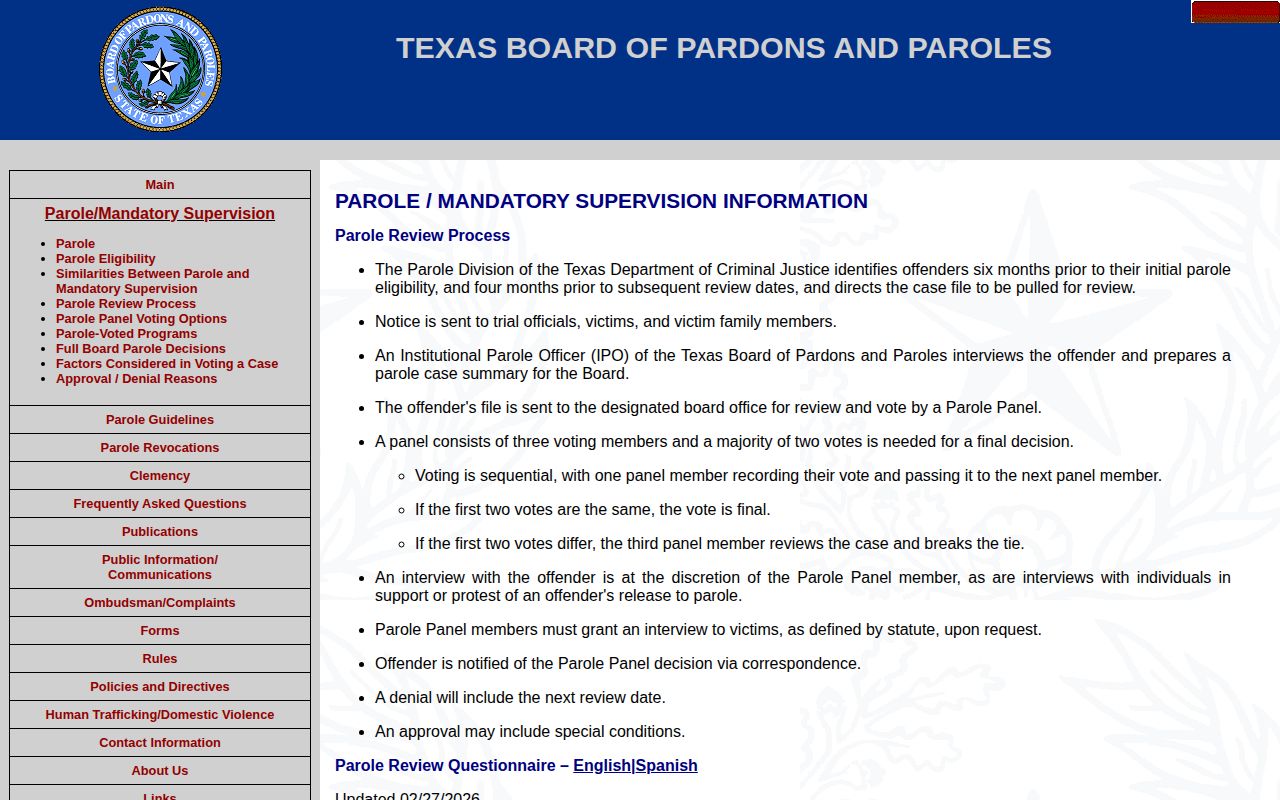
The agency screen reinforces that Orange County parole questions follow the statewide file-review process, not a county hearing calendar.
The public Board meeting calendar contains meeting notices and minutes, but it is not a calendar of individual reviews. Government Code §508.145 sets eligibility rules. Sections 508.147 and 508.149 address mandatory supervision and exclusions. Offense, offense date, sentence, and special categories all affect the result.
Orange County Parole Decision Codes
A favorable vote can still precede weeks of release processing. TDCJ checks the release plan, county restrictions, discipline, required programs, special conditions, and other criteria before issuing a certificate. Classification and Records may then need time to audit and calculate the release. Program-based votes depend on successful completion and an approved residence.
The Board voting-options page is the official dictionary for results such as FI-1, FI-2, program-conditioned FI-R votes, denial with a later review, and serve-all. A new fact may also cause withdrawal of an approval.
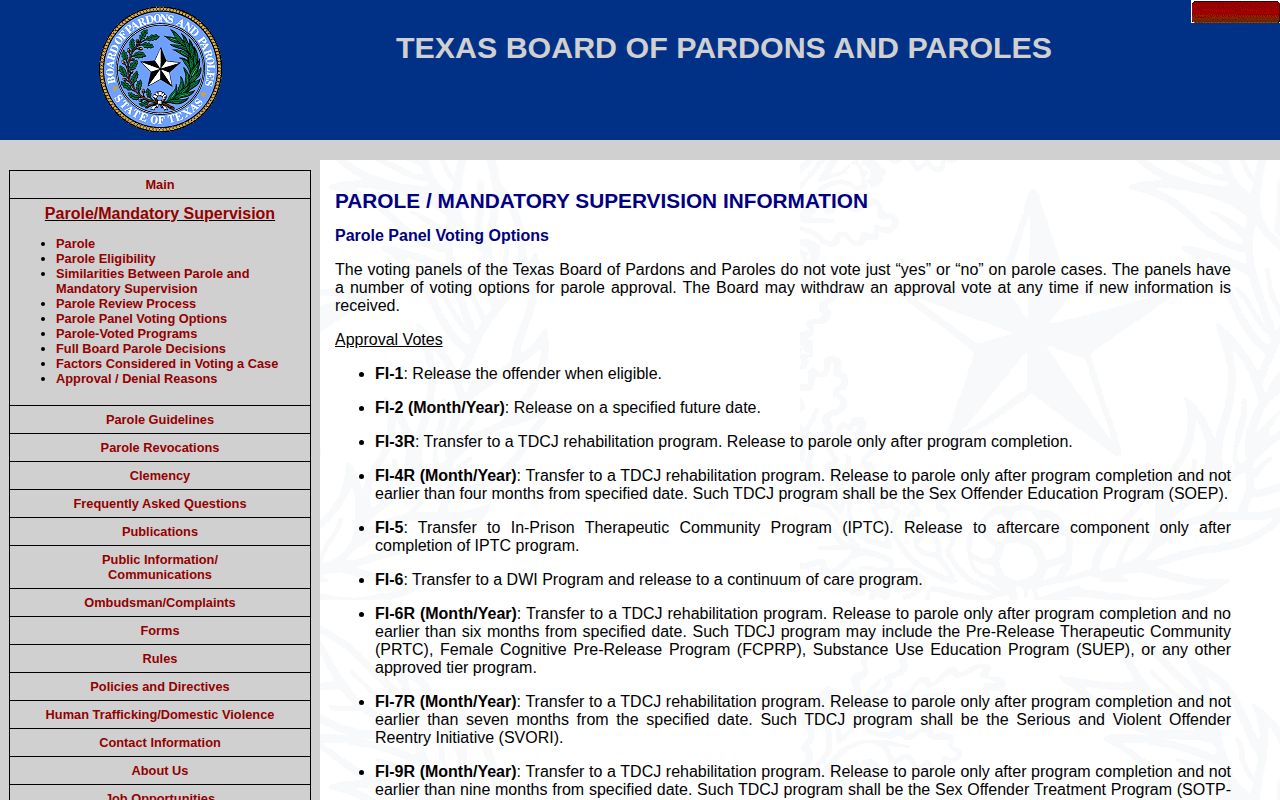
Reading the code beside the official explanation prevents an approval condition from being mistaken for immediate physical release.
A Parole in Absentia case released from a county jail is a special local concern. TDCJ says its date may not post online through the usual Classification and Records process. In that case, use Board or Huntsville status plus the Orange County book-out record.
Orange County Warrants After Release
Orange County publishes an All Active Warrants page and directs warrant information to the sheriff at (409) 883-2612. This is not a parole absconder database. It identifies a separate local court or law-enforcement process that may continue after one booking ends.
A warrant can explain why release on one matter is followed by immediate arrest or transfer. A parole violation warrant, probation revocation action, and unrelated county warrant are different records. Read the agency and cause number before drawing a conclusion. TDCJ also publishes a narrow sex-offender absconder channel, but absence from that list does not prove that all supervision terms are being met.
For a status change alert, the current county channel is IVSS-Counties, while TDCJ uses its own IVSS for prison and parole events. The separate VINE Inmate Check explains that split.
Note: A warrant record can explain renewed custody, but it cannot by itself prove the date or terms of an earlier Orange County release.
Orange County Probation Reporting Access
Orange County Adult Probation’s online CaseConnect route is designed for people already assigned to supervision. It requires a Web Reporting ID issued by an officer, the date of birth stored in the system, account credentials, and email activation. It is not a public lookup for neighbors, family members, or other searchers.
The specialized staff list also does not disclose a client’s conditions. SAFPF refers to a secure substance-abuse treatment facility, while ISF is an intermediate sanction facility. Interstate transfer staff coordinate supervision across state lines. Indirect supervision and presentence work serve different case stages. Call the main office with the cause number when the public judgment does not show which unit has the file.
Verification remains document-based. The judgment establishes the sentence. Later court orders show changes, revocation, or discharge. The office can route a proper inquiry, but access credentials should come only from the assigned officer.
Correct Orange County Supervision Errors
Orange County’s records process has a useful identity-control rule. Its no-charge Incarceration Photo is available as proof of identity only when the requester supplies state identification and signs that the requester is the person shown. This is not a general photo-search route.
For an error in a local booking or release record, send a focused correction request to the Orange County Sheriff’s Office with the booking identifiers and a document showing the conflict. If the error is in a misdemeanor or felony court record, contact the correct clerk and court. TDCJ record errors belong with TDCJ rather than the county jail.
Government Code Chapter 552 provides access to public information but also preserves corrections, privacy, safety, victim, medical, and sealed-record limits. Ask for segregable public portions when a file includes protected material. The complete Orange County release-search and records-request path appears on the home page.
Confirm Orange County Supervision Discharge
A parole discharge means the remaining sentence and supervision obligation ended. A probation discharge comes through the Orange County court and CSCD process. Neither event should be inferred because a name disappears from a portal, a term seems old, or no staff member confirms details by phone.
Obtain the final agency record or court order. Compare the person’s identifiers, case number, date, and scope. One discharged case does not resolve another open cause, warrant, detainer, or supervision term. A TDCJ release status may mean parole rather than full discharge, and leaving the county jail may mean transfer rather than community release.
These distinctions protect accuracy. They also direct the request to the office that created the record: TDCJ and the Board for state parole, Orange County courts and Adult Probation for community supervision, and OCSO for the underlying county-jail book-out.